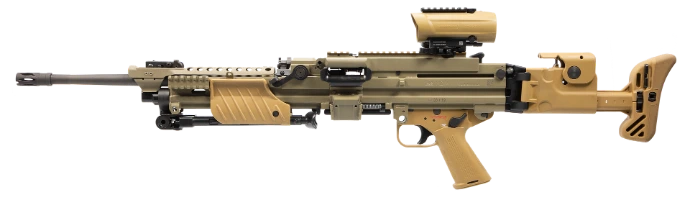
MG4 K
- Multiple sear notches on the bolt head carrier
- Capable of withstanding barrel obstructions as per NATO AC225/D14 (DM41, DM11, DM31, DM21)
- Drop test as per NATO AC225/D14
- Low-maintenance, reliable weapon system in the high- and low-temperature range according to NATO AC225/D14
- Climate-tested machine gun (difficult operational conditions)
- The weapon can be set to safety in any loading state.
- Barrel change without protective gloves
- Barrel lock prevents unintentional unlocking of the barrel
- Day/night combat capability (image intensifier/thermal imaging)
- Foldable and length-adjustable buttstock with height-adjustable cheek rest
- NATO STANAG 4694 Picatinny rail for mounting sights and sighting accessories
- Mount interface (US M122 tripod)
- Reliable belt traction performance thanks to proven two-tier belt feed system
- Belt feed with loaded state indicator
- HK precision barrel made of cold hammer-forged and hard chrome-plated special steel
- Various barrel lengths as quick-change barrel with carrying and barrel changing handle
- Simple conversion to standard, infantry or remote-controlled weapon at user level
- Remote control grip for mounted weapon configuration
- Largely identical operation and handling to the MG5
- As training system with BFA
Specifications
Caliber
5.56 mm x 45 NATO
Modes of Fire
Full-Auto
Rate of Fire
830 Rd/min
Max Effective Range
600 m
Muzzle Velocity
880 m/s
Muzzle Energy
1548 J
Max Length
1005 m
Max Width
130 mm
Barrel Weight
1.5 kg
Weapon Weight
8.4 kg
Barrel length
370 mm
Height
230 mm
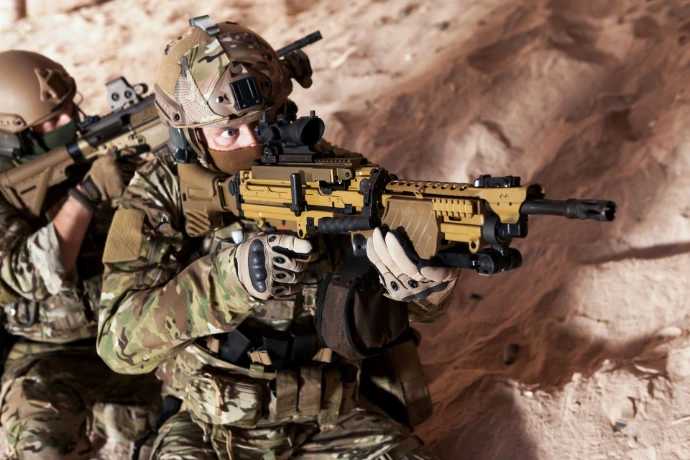
Chassis
The MG4 K features a compact, lightweight receiver design that enhances maneuverability while maintaining durability.
Operation
It uses a gas-operated system with a rotating bolt to ensure reliable cycling during sustained fire.
Bolt Carrier Group
A compact, optimized bolt carrier group designed for the MG4 K, ensuring reliable cycling, reduced mass, and consistent performance in short-barrel, high-mobility configurations.
Maintenance
Routine maintenance involves clearing the weapon and cleaning and lubricating the bolt group, barrel, and gas system to support consistent performance.